Inside the Build: Precision Stair Construction in Active Office Environments
Installing a staircase inside an occupied commercial building is one of the more technically demanding interior construction challenges in modern office development.
It requires more than construction capability. It requires judgment.
Active office construction projects operate in environments where business continuity matters. Employees are working, clients are visiting, and building systems remain live throughout the work.
A successful stair installation inside an occupied space is not defined by the steel that is fabricated or the concrete that is poured. It is defined by how safely and seamlessly the work is delivered inside a functioning commercial environment.
Scott + Reid specializes in structural and ornamental stair systems for office construction and commercial interior renovation projects where precision, safety, and architectural integration are critical. As a commercial office contractor, we focus on solving the problem before construction begins.
The Complexity of Stair Construction in Occupied Buildings
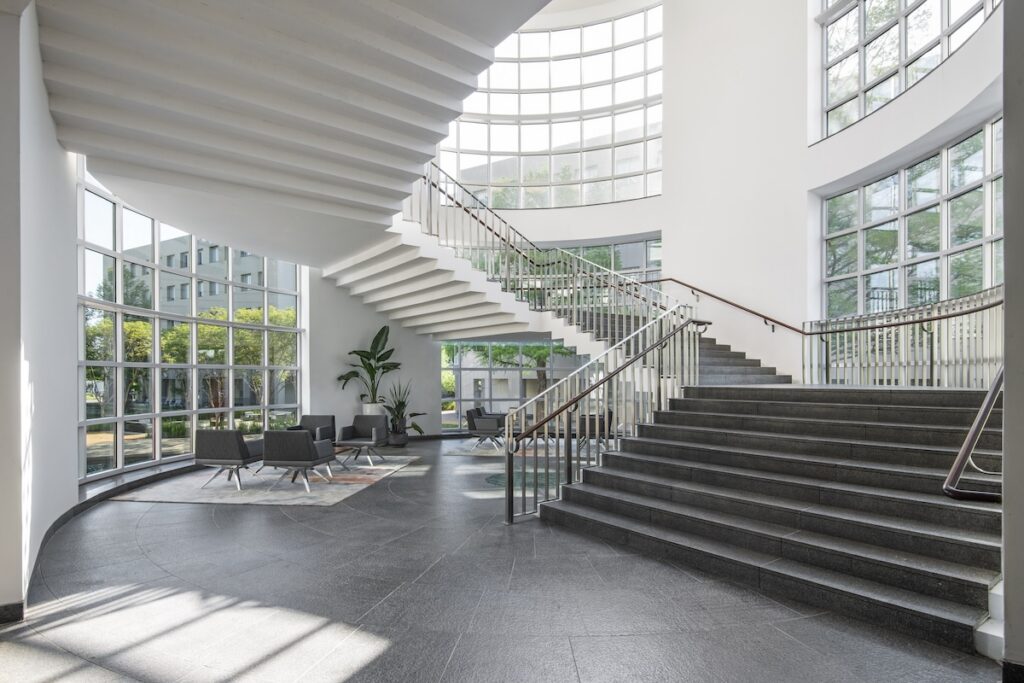
Solana
Stair construction inside an active commercial building is fundamentally a coordination exercise. The challenge is not simply building the structure. The challenge is building it while working around tenant operations, security requirements, building infrastructure, and existing mechanical and electrical systems. Older commercial buildings often introduce additional uncertainty. Concrete slabs may have minor dimensional variation from original drawings. Utilities are frequently concealed within floors and walls. Structural reinforcement and post-tension systems may be hidden below the surface.
For this reason, stair projects inside occupied office spaces must begin with verification, not fabrication. Without proper field validation, contractors risk material misalignment, schedule disruption, and unnecessary tenant disturbance. Experience is the primary risk mitigation tool.
Engineering the Work Before Construction Begins
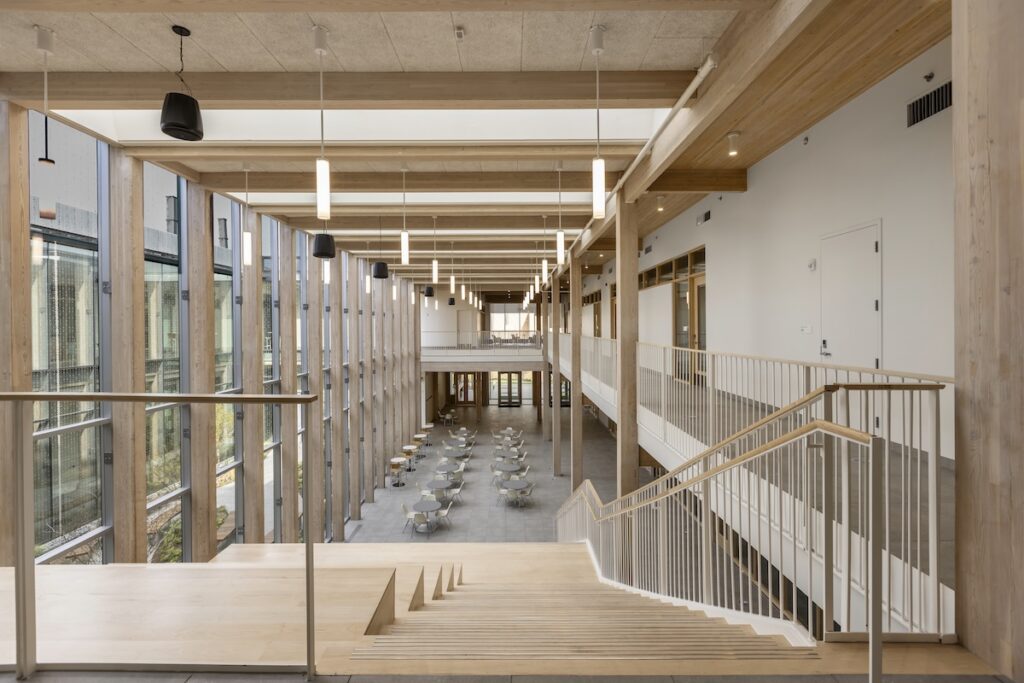
Greenhill School
Successful commercial interior construction starts with planning at the microscopic level. Scott + Reid coordinates early with architects, structural engineers, building ownership teams, and specialized subcontractor partners to establish a shared understanding of project conditions. Our process emphasizes three foundational elements.
- Field Verification of Existing Conditions
Shop drawings are developed from actual field measurements rather than assumptions derived from legacy construction documents. Accurate dimensional validation reduces installation uncertainty and supports efficient fabrication sequencing.
- Subsurface Safety Assessment
Before concrete removal occurs, independent specialists often perform ground-penetrating radar scans to identify embedded conduit, plumbing lines, reinforcing steel, and post-tension cables. Protecting structural systems is not optional. It is fundamental to responsible commercial construction.
- Controlled Work Environments
Construction inside occupied office buildings requires environmental containment. Temporary enclosures, dust suppression systems, negative air pressure zones, and engineered shoring structures help maintain a clean and safe workspace for both occupants and construction crews. Safety, cleanliness, and operational respect are treated as core project deliverables.
Collaboration With Specialized Technical Teams
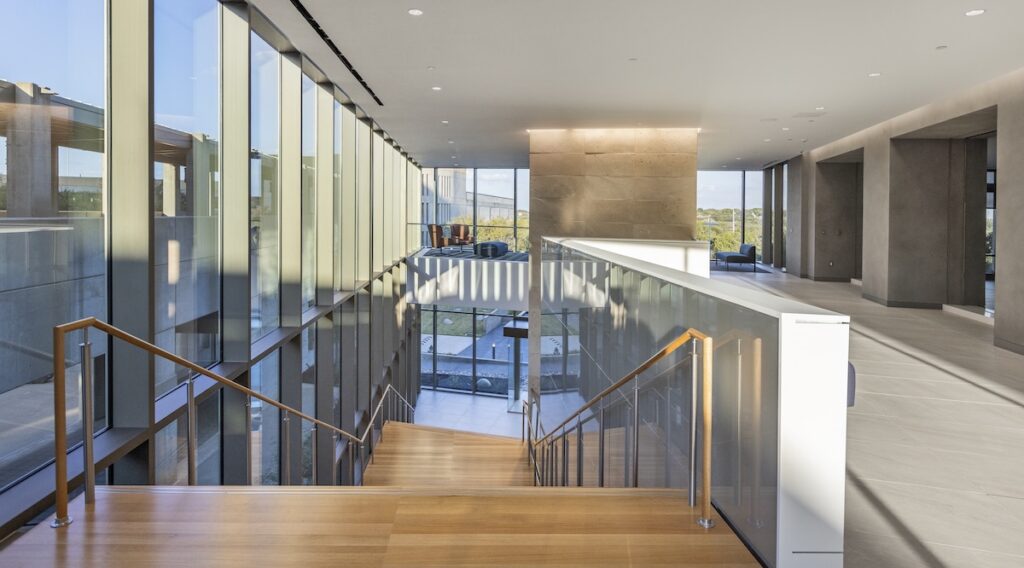
Kirkwood Oaks
Stair systems inside commercial interiors are rarely installed by a single trade.
Successful projects depend on coordinated execution across multiple technical disciplines, including:
- Structural and design engineering partners
- Specialty steel fabrication and ornamental metal teams
- Independent welding inspection and testing agencies
- Mechanical, electrical, and building operations stakeholders
- Property management and tenant representatives
Field weld verification and structural testing are performed by qualified third-party inspectors to confirm installation integrity. When required, shoring towers, catch basins, and temporary load-bearing systems are used to maintain structural stability during installation.
Prefabrication and Logistics Planning
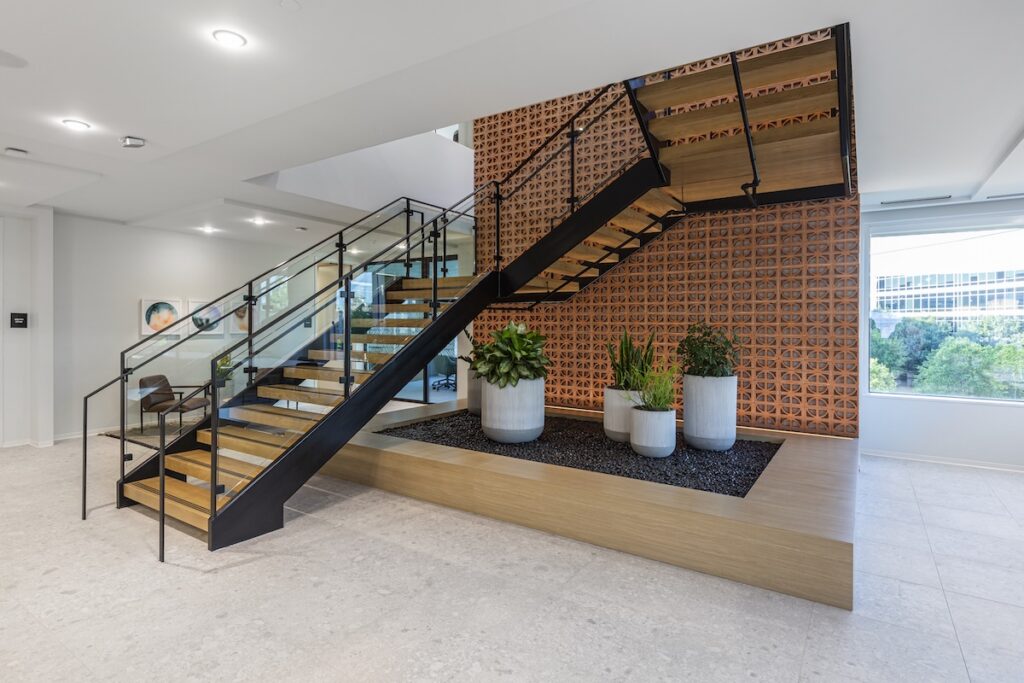
CBRE
Office construction projects present physical constraints that do not exist in ground-up construction. Freight elevators may be limited. Corridors may be narrow. Materials may need to move through occupied tenant space.
To manage these realities, stair components are frequently fabricated offsite in segments optimized for building access and delivery logistics. Prefabricated stringers, treads, and risers improve quality consistency, reduce onsite noise, and shorten installation duration.
This approach reflects a broader philosophy in modern commercial construction: quality is improved when controlled manufacturing and field installation are integrated.
Staircases as Architectural Statements in Modern Office Design
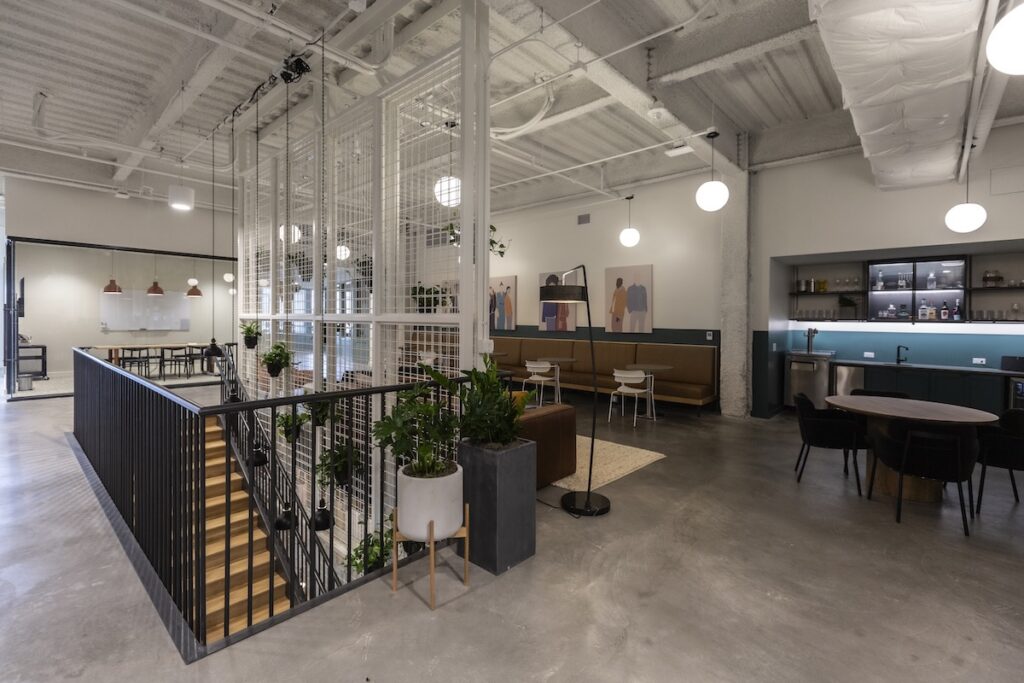
Common Desk
In contemporary office environments, staircases are no longer treated solely as circulation infrastructure. They are design features.
A well-executed stair can help define spatial movement, create visual continuity across floors, and reinforce the architectural character of a workspace. In many modern commercial interiors, the stairs become a signature visual element that reflects the identity of the organization occupying the space.
Whether the design intent is modern minimalism, industrial character, or traditional refinement, the objective remains the same. Structural durability, safety performance, and aesthetic quality must function together.
Experience Matters in Office Construction
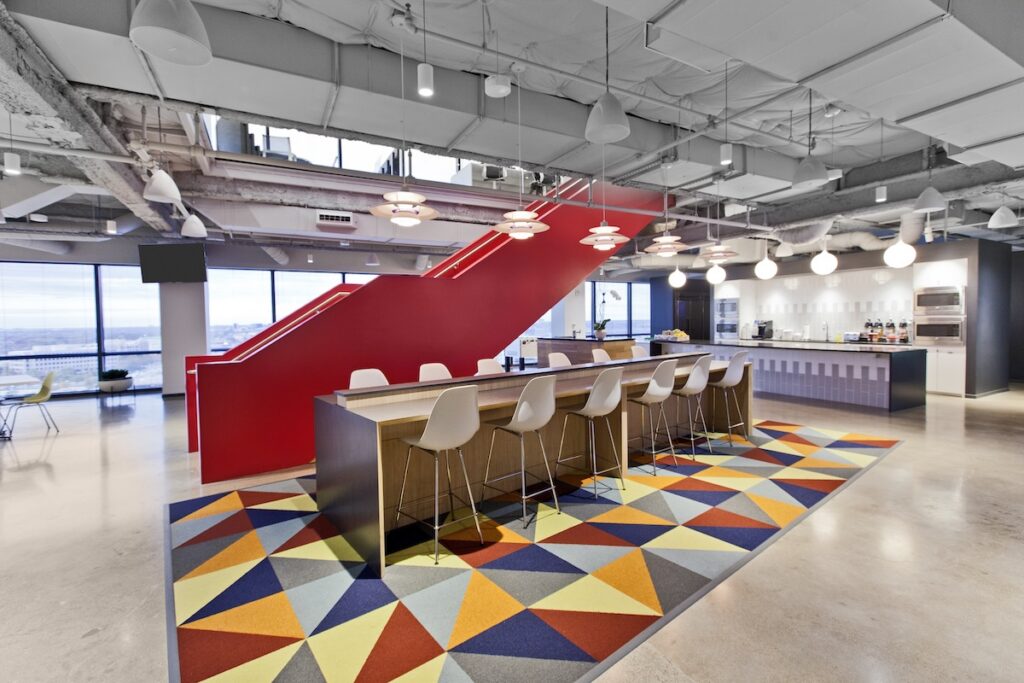
Match.com
Stair installation inside occupied buildings demands construction judgment that is developed over years of working in real commercial environments. Scott + Reid collaborates with architects, engineers, building owners, and specialized subcontractor teams to deliver interior stair systems that are structurally reliable, visually refined, and operationally responsible. We focus on office construction and commercial interior projects where coordination, environmental control, and tenant awareness are as important as technical craftsmanship.
The highest quality stair installations are often the ones that occur without disruption to the people working inside the building. Because in premium commercial construction, success is measured not only by what is built, but by how intelligently and respectfully it is delivered.